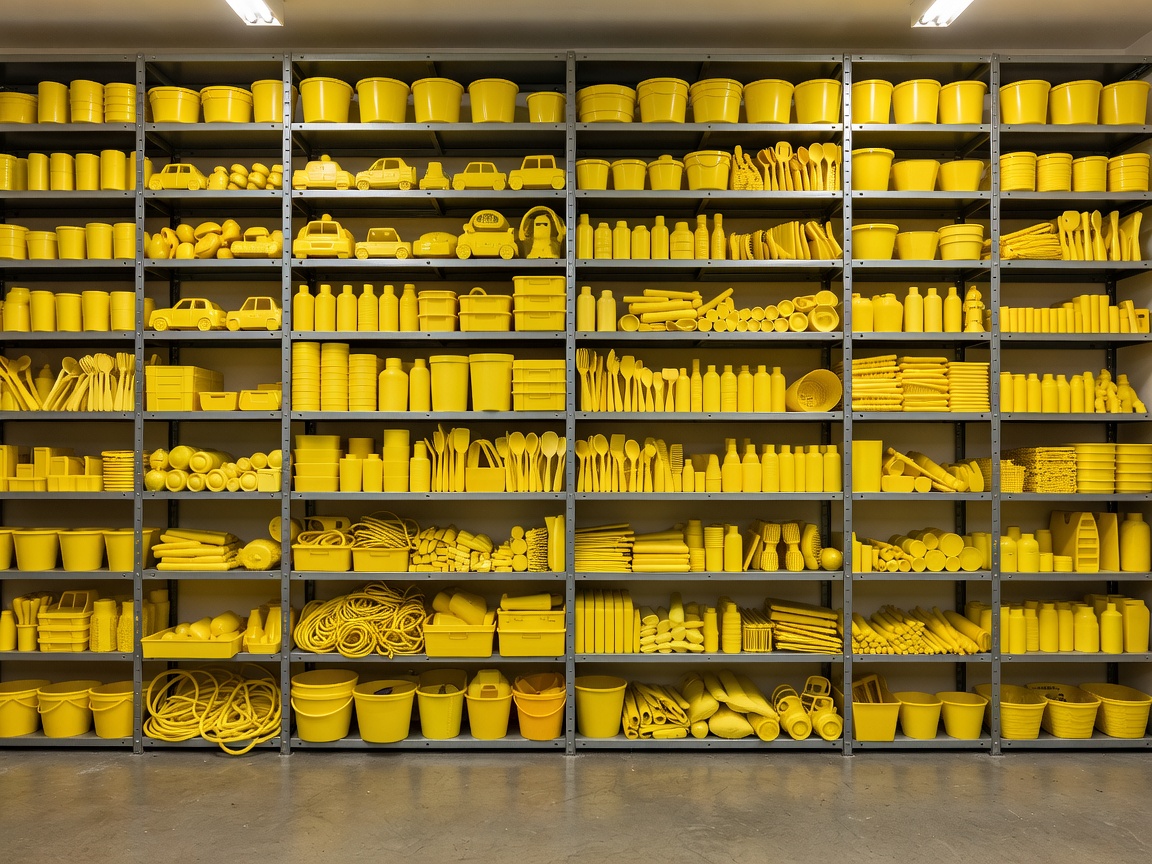
Collecting is a standard human behavior, serving functions from historical preservation to personal psychological comfort. However, when a collection expands into the tens of thousands of units—specifically focusing on a singular novelty item like the rubber duck—it transitions from a hobby into an exercise in advanced logistics, database management, and structural engineering.
Spatial Parameters and Structural Load
The primary barrier to extreme accumulation is physical space. A standard bath duck has dimensions roughly equivalent to an 8cm cube. While seemingly insignificant individually, accumulating 10,000 units requires a minimum of 6.5 cubic meters of pure storage space, assuming perfect tessellation without any shelving infrastructure.
In reality, collections are displayed, not densely packed. Displaying such a collection requires extensive custom carpentry. Floor-to-ceiling shallow shelving is mandatory. Furthermore, while polyvinyl chloride (PVC) or rubber is relatively lightweight, the aggregate mass of a massive collection can place significant localized static loads on residential flooring, occasionally necessitating structural reinforcement of joists in domestic settings.
Database Management and Verification
In the realm of official record-keeping, quantity alone is insufficient; uniqueness is paramount. A collection of 10,000 identical items is considered a hoard of inventory, not a collection. Adjudicating bodies require proof that each item is distinct in mold, coloration, or manufacturer.
Managing this requires enterprise-level cataloging:
- Relational Databases: Collectors must utilize software to track acquisition dates, manufacturer origin, subtle mold variations, and physical location within the display matrix.
- Barcoding/RFID: Advanced collectors apply micro-labels to the underside of units to prevent duplication and assist auditors during verification counts, which can take a team of adjudicators several days to complete.
Material Degradation and Preservation
Synthetic rubber and PVC are not archival materials. Over decades, they are susceptible to plasticizer migration, where the chemicals that make the plastic soft leach out, resulting in the item becoming brittle and "weeping" a sticky residue. Furthermore, UV exposure causes severe photodegradation, fading the bright yellow pigments to brittle white or brown.
Maintaining a massive collection requires climate control. Ideal conditions involve blocking all natural UV light, maintaining strict temperature stability (around 18°C), and controlling humidity to prevent the breakdown of the polymers. Dusting a collection of this magnitude is a continuous, cyclical task that can occupy several hours a week.
The pursuit of the largest rubber duck collection is ultimately a study in the human desire to impose order and categorization upon a mass-produced, chaotic consumer market.